
Many traders assume that once they’ve entered a username and password on an exchange and toggled 2FA, the job is done. That’s a seductive simplification but the real security and operational story is more layered. Using a US-based trader’s routine of logging into an OKX account and moving between spot, margin, and futures as a running example, this article peels back those layers: how OKX’s login and account systems actually work, where they reduce risk, and where user behavior or systemic trade-offs leave holes that matter in practice.
The goal is not to praise or bash OKX; it is to translate platform mechanics into decision-useful guidance for US crypto traders. I’ll explain how the login stack functions, compare trade-offs between custodial and self-custodial options, show how futures access amplifies both opportunity and risk, and close with clear heuristics you can apply the next time you click “sign in.”
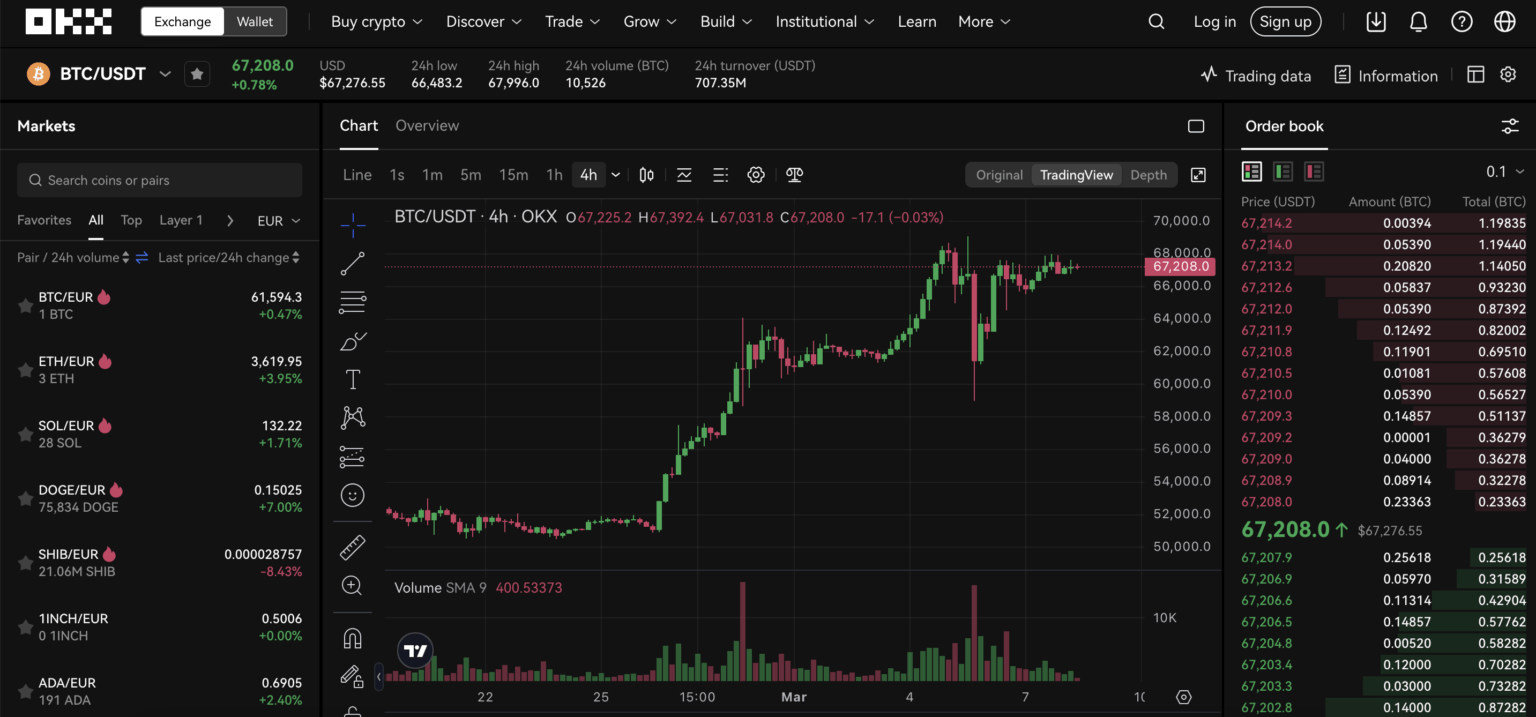
Mechanics: what happens when a US trader logs into an OKX account
At a technical level a login is a chain of authentication, session management, and risk-scoring. OKX combines standard credentials with mandatory KYC (Know Your Customer) checks and mandatory two-factor authentication (2FA). On top of that the platform applies AI-driven real-time detection to flag unusual logins — for instance a new IP, a different device, or an impossible travel scenario. The immediate consequence: the exchange can block or throttle access until the user verifies identity again.
Mechanism matters because it shapes what threats the system mitigates. Passwords and 2FA protect against credential stuffing and casual account takeover. Cold-storage custody (where OKX keeps >95% of assets offline with multi-signature withdrawal approvals) reduces large-scale hacker payoff even if web-facing systems are breached. Proof of Reserves (PoR) adds a transparency layer so users can check whether on-chain balances match declared liabilities. But each of these controls covers a different failure mode — and none removes user-side operational risks like phishing or seed loss for private wallets.
Where account security reduces risk — and where it doesn’t
Security wins: mandatory KYC and liveness checks make it harder for automated fraud rings to create anonymous accounts at scale, and multi-sig cold wallets materially reduce the risk of a single breach leading to mass withdrawals. PoR publishes an audit trail that can be inspected on-chain — a rare, useful guardrail against solvency surprises.
Limits and trade-offs: mandatory identity checks improve compliance but create a single point of friction for users who value privacy. Cold storage protects against hot-wallet compromise, but it can slow legitimate withdrawal processes and depends on trustworthy governance for key-signing. Most importantly for traders: platform-level protections do not help if you voluntarily approve a malicious transaction in a Web3 interaction or if you lose your self-custodial seed phrase. In other words, custody shifts risk, it doesn’t eliminate it.
Futures and leverage: the interface of login friction and market risk
OKX offers a broad derivatives menu — quarterly futures, perpetual swaps, and options, with leverage up to 125x on some products and up to 10x on spot-margin. For a US trader, that availability is a double-edged sword. Mechanically, higher leverage magnifies P&L and the speed at which margin calls and liquidations occur. Operationally, anything that delays account access — a frozen session pending re-authentication or a locked 2FA device — can mean you miss a critical margin call. That is where login hygiene intersects with trading risk: a secure but awkward login flow can produce latency that materially impacts a leveraged position.
Practical implication: treat account access as part of your risk control layer. Maintain at least two independent, secure 2FA methods where the platform allows (e.g., hardware token plus authenticator app), and understand how OKX’s cross-margin and isolated-margin modes behave on a sudden price move. If you run automated strategies or use the API, keep API permissions tightly scoped and monitor the IP and permission logs for anomalies.
Custodial vs. self-custodial inside the OKX ecosystem
OKX is hybrid: it operates a centralized exchange and also provides a non-custodial Web3 wallet that supports hardware keys and connects to DApps. This is not just a marketing point — it forces a strategic choice. Using OKX’s custodial exchange is convenient for high-frequency trading, staking, and quick access to yield products (including auto-compounding staking and DeFi farming). The exchange’s cold storage and PoR mechanisms mitigate some platform-level counterparty risk.
By contrast, the non-custodial wallet hands private key responsibility back to the user. That removes counterparty risk but adds self-custody risks: lost seed phrase equals permanent loss, and interacting with DeFi protocols brings smart contract risk and exposure to phishing. The trade-off is classic: liquidity and convenience versus absolute custody control. For US traders, regulatory and tax reporting considerations also differ between the two modes — custodial platforms typically provide consolidated tax documentation and KYC metadata that self-custodial wallets do not.
A concrete case: delisting, portfolio exposure, and account choices
Consider a recent routine change: the delisting of several spot pairs (RSS3, MemeFi, GHST, RIO, SWEAT). For an account holder, delisting is a common operational event with practical consequences. Mechanistically, delisting removes market liquidity for certain pairs on the platform and may force traders to convert holdings to other assets before a deadline. If a trader holds a delisted token in custody at the exchange, OKX typically provides withdrawal windows and instructions. If the asset is illiquid, the effective cost to exit can be high due to slippage and wide spreads.
Decision framework: if you rely on the exchange for custody, treat delistings as an ongoing governance risk — exchanges will prune listings to manage liquidity and compliance. If you hold niche tokens, keep a plan: either keep them in a self-custodial wallet or be ready to move them ahead of delisting notices. And always check how delisting timelines interact with KYC or withdrawal limits on your account.
Practical heuristics for US traders logging into OKX
1) Harden initial access: use password managers, enable hardware-backed 2FA where possible, and register a biometric method on mobile for convenience without sacrificing security. 2) Split operational roles: keep the bulk of long-term holdings in cold storage or a hardware wallet and keep a smaller hot balance for active trading. 3) Treat login alerts seriously: unexpected device or IP notifications are not nuisances — they are leading indicators of social engineering or credential compromise. 4) Before trading futures with leverage, simulate worst-case latency: how much price movement would liquidate your position if you were temporarily locked out? 5) For API users, rotate keys regularly and restrict IPs and permissions; monitor the exchange’s session log daily if you trade large sizes.
Where this framework can fail — unresolved trade-offs
No single approach perfectly balances convenience, privacy, and security. Relying entirely on exchange custody improves accessibility and tax reporting but creates concentration risk. Relying entirely on self-custody avoids counterparty failure but exposes you to irreversible human error. Even technical mitigations like PoR and multi-sig depend on meaningful transparency and competent operational governance — both of which require ongoing audit and scrutiny. Finally, regulation matters: US-based traders face evolving AML/KYC requirements that could change product availability or reporting obligations, and those are exogenous constraints that individual security choices cannot control.
To make the jump from understanding to practical action, bookmark the exchange’s verified login guidance and review your own account settings once a month. If you need a quick refresher on accessing OKX’s login pages and multi-factor options, the official portal and help pages are a useful starting point: okx login.
What to watch next — signals that matter for traders
Monitor four signals: (1) changes to KYC or withdrawal policy from OKX that affect US accounts; (2) delisting notices and liquidity warnings for pairs you hold; (3) adjustments to leverage caps on specific derivatives (these often precede stressed markets); and (4) security incident reports or updates to Proof of Reserves that change the transparency picture. Each signal has a clear mechanism: policy changes alter access; delistings affect exit liquidity; leverage caps change liquidation dynamics; and transparency updates change counterparty trust. Taken together they let you adapt position sizing and custody decisions dynamically rather than reactively.
FAQ
Q: If I enable biometrics on the OKX mobile app, is that safer than SMS 2FA?
A: Yes and no. Biometric login on a device reduces the risk from SIM-jacking and intercepted SMS messages, and it’s often faster. But it creates device dependence: if you lose the device and haven’t set up backup 2FA or account recovery, reaccess can be painful. Best practice is layered 2FA (biometric plus authenticator app or hardware key) and a secure backup of recovery codes stored offline.
Q: Should active futures traders keep funds on OKX or on a hardware wallet?
A: For active futures trading you need funds available on the exchange to meet margin requirements and exploit liquidity. That argues for keeping a working balance on the exchange. Simultaneously, long-term reserves should remain in cold storage or a hardware wallet. The right split varies by strategy size: a heuristic is to keep only the collateral needed for your typical trading horizon on-exchange and everything else offline.
Q: How does Proof of Reserves change the trust model for OKX?
A: Proof of Reserves adds an on-chain check that can validate aggregate backing at a snapshot. It doesn’t eliminate operational risk, and it doesn’t prove the timeliness or usability of those reserves under stress. Think of PoR as a transparency tool that reduces information asymmetry but not as a panacea for custody risk.
Q: What should I do if a token I hold is announced for delisting?
A: Act sooner rather than later. Check withdrawal windows and destination chain support; if liquidity looks thin, consider converting to a stablecoin or a major base asset while spreads are reasonable. If you prefer to keep the token, move it to a self-custodial wallet where you control the private keys and can use cross-chain bridges or DEX aggregators to find liquidity elsewhere.